Category 03 · 40 metres and above
Super yachts
Beyond forty metres the proposition changes entirely. Not a larger yacht — a private estate that moves, with the staff, the logistics and the regulation that implies.
- Length overall
- 40 – 120 m
- Guests sleeping
- 12 – 24
- Crew
- 12 – 30
- Pricing
- Not currently published
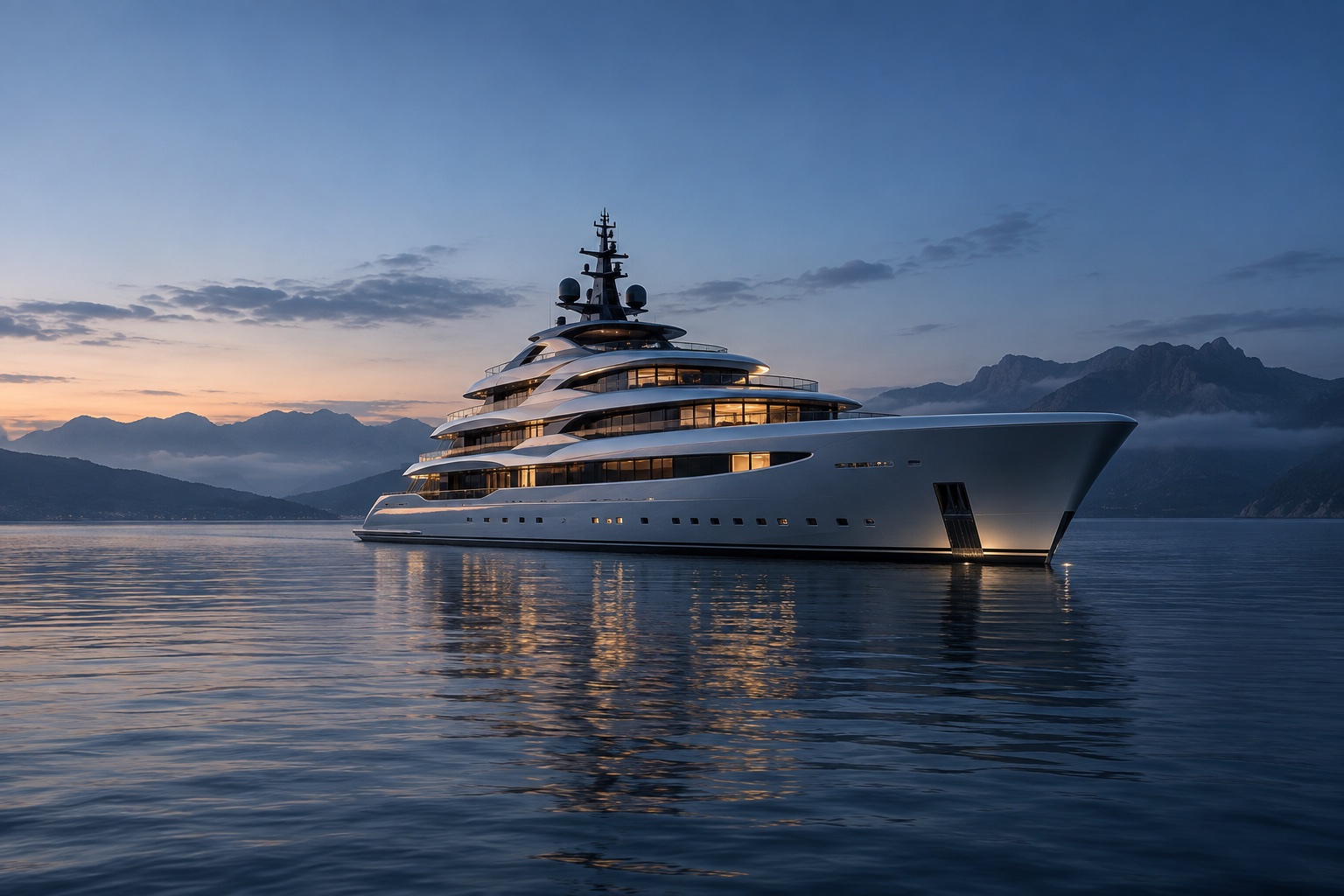
What the category covers
Forty metres is the conventional threshold, though the meaningful line is regulatory rather than dimensional. Above five hundred gross tons a vessel falls under a materially heavier code — the Large Yacht Code in the British system, or its equivalents — which dictates crew certification, watertight subdivision, fire safety and manning. The practical consequence is that a superyacht is operated much more like a small commercial ship than like a large boat.
Most vessels in this category are steel-hulled with aluminium superstructures and displacement hulls, cruising at eleven to fourteen knots with transatlantic range. Layout runs across three or four decks: a beach club at water level aft, main deck with the principal saloon and often a full-beam owner’s suite forward, an upper deck with a second, more private saloon and the bridge, and a sun deck carrying the pool, the bar and frequently a touch-and-go helideck.
Crew are the defining feature. Twelve to thirty people, in departments — deck, interior, engineering, galley — under a captain who is running a business as much as a vessel. At this scale the interior team includes dedicated stewardesses, often a head chef and a sous chef, and on many vessels a purser handling accounts and logistics. Service is continuous and largely invisible, which is precisely what it is for.
Who it suits
Large parties. This is the only category that comfortably accommodates twelve to twenty guests without anybody feeling they drew the short cabin. Multi-generational family gatherings, milestone birthdays and groups travelling together with staff of their own are the natural briefs.
Hosting. If the week involves entertaining people who are not staying aboard — dinners for thirty at anchor off Cap Ferrat, a lunch during a Grand Prix or a regatta — a superyacht is built to do it and nothing smaller is. Galleys at this size can produce a served dinner for forty; a thirty-metre motor yacht cannot.
Guests who want genuine amenity. Spa and treatment rooms, gyms with a view, cinemas, swimming pools with counter-current, dive centres with a compressor and a certified instructor, tenders of nine metres and above, and a beach club that opens onto the sea on three sides. These are real and they are used.
It does not suit anyone whose priority is intimacy or spontaneity. A vessel of this size requires berths booked months ahead, cannot enter many of the prettiest small harbours, and moves with a certain deliberation. Guests who want to change plan over breakfast and be somewhere else by lunch are better served two categories down.
What to look for
Guest certification limit
Most privately registered yachts may carry no more than twelve guests at sea, regardless of how many beds are aboard. Vessels certified under a passenger yacht code can carry more, but there are relatively few of them and they command a premium. If your party is thirteen or more, this is the first question, not a detail — and it is the point on which enquiries most often collapse late.
Crew-to-guest ratio and department depth
Twenty crew for twelve guests is generous; the same twenty for twenty-two guests is adequate rather than luxurious. Ask for the crew list by department. A galley with one chef and no sous chef will struggle to deliver three distinct meals a day to twenty people for a fortnight, whatever the brochure implies.
Beach club and tender garage
The beach club is the most-used space on a modern superyacht and the quality varies enormously — from a genuine sea-level room with a bar, gym and fold-down terraces to a converted tender garage with a mat on the floor. Ask for photographs taken with the platforms open, and ask how long the tenders take to launch, because on some vessels it is forty minutes.
Helideck: touch-and-go or certified landing
These are different things. A touch-and-go deck permits a helicopter to land briefly to embark or disembark; a certified landing deck permits it to shut down and remain. If you intend to keep a helicopter aboard, confirm which you are getting and confirm the aircraft type is within the deck’s limits.
Where she has actually been
A yacht that has spent five seasons between Monaco and Porto Cervo is a known quantity in those waters. The same vessel proposed for a Norwegian summer or an Indian Ocean crossing is a different risk. Ask for the last three seasons’ itineraries — it tells you what the crew genuinely knows.
How the total is structured
No rates are published during the site’s educational stage. At this scale, yacht, season, itinerary, repositioning, tax and operating plan change the total materially, so only a current written quote for the actual arrangement is useful.
Advance Provisioning is 25 to 35 per cent, and the absolute numbers are substantial — a fortnight’s fuel alone on a seventy-metre yacht moving regularly runs well into six figures. Berthing is the other large line: a peak-season berth in Monaco, Porto Cervo or Saint-Tropez for a vessel of this size is charged per metre at rates that surprise people, and in the busiest weeks it may not be available at any price without months of notice.
Delivery and redelivery fees apply if the yacht must reposition to meet you. VAT treatment depends on flag, itinerary and where the charter starts, and at this level it is worth having it confirmed in writing by the central agent before signature. Crew gratuity is customary at five to fifteen per cent, and on a vessel with twenty-five crew it is a meaningful sum that should be budgeted rather than improvised on the last morning.
Where it works
The French and Italian Rivieras remain the centre of gravity — Monaco, Saint-Tropez, Cannes, Portofino and Porto Cervo — because the infrastructure exists for vessels of this size and because the social calendar is there. Berths must be secured early.
The Caribbean in winter, principally Saint Barthélemy, Antigua and the Virgin Islands, is the second season, with New Year in Saint Barth’s committed a full year ahead as a matter of routine.
The Eastern Mediterranean is increasingly used, with Greece and Turkey offering deep anchorages that suit large vessels well, though marina capacity in the islands is limited and much of the week will be spent at anchor — which, with a good beach club and reliable tenders, is frequently the better week anyway.
Longer programmes — the Indian Ocean, South East Asia, the South Pacific and Alaska — are entirely feasible for vessels with the range and the crew, and are arranged as multi-week charters with careful attention to permits, provisioning and medical support.
Our usual advice
Decide the guest number before you fall in love with a vessel. Thirteen guests eliminates roughly nine tenths of the fleet at a stroke, and discovering that after you have set your heart on a particular yacht is the most avoidable disappointment in this category.
Questions
International convention treats a vessel carrying more than twelve passengers as a passenger ship, which triggers a far heavier safety regime covering subdivision, evacuation and structural fire protection. A small number of yachts are built or converted to meet it; the rest are limited to twelve at sea however many beds they have.
For August in the Western Mediterranean or Christmas and New Year in the Caribbean, twelve months is normal for the most desirable vessels and is not excessive. Shoulder season can often be arranged within three months, and the weather is usually better.
Frequently yes — nannies, security and personal assistants are common. They occupy guest cabins and count toward the guest limit unless the vessel has dedicated staff accommodation, which the larger yachts do. It must be agreed before contract, not on arrival.