Category 02 · 20–60 metres
Sailing Yachts
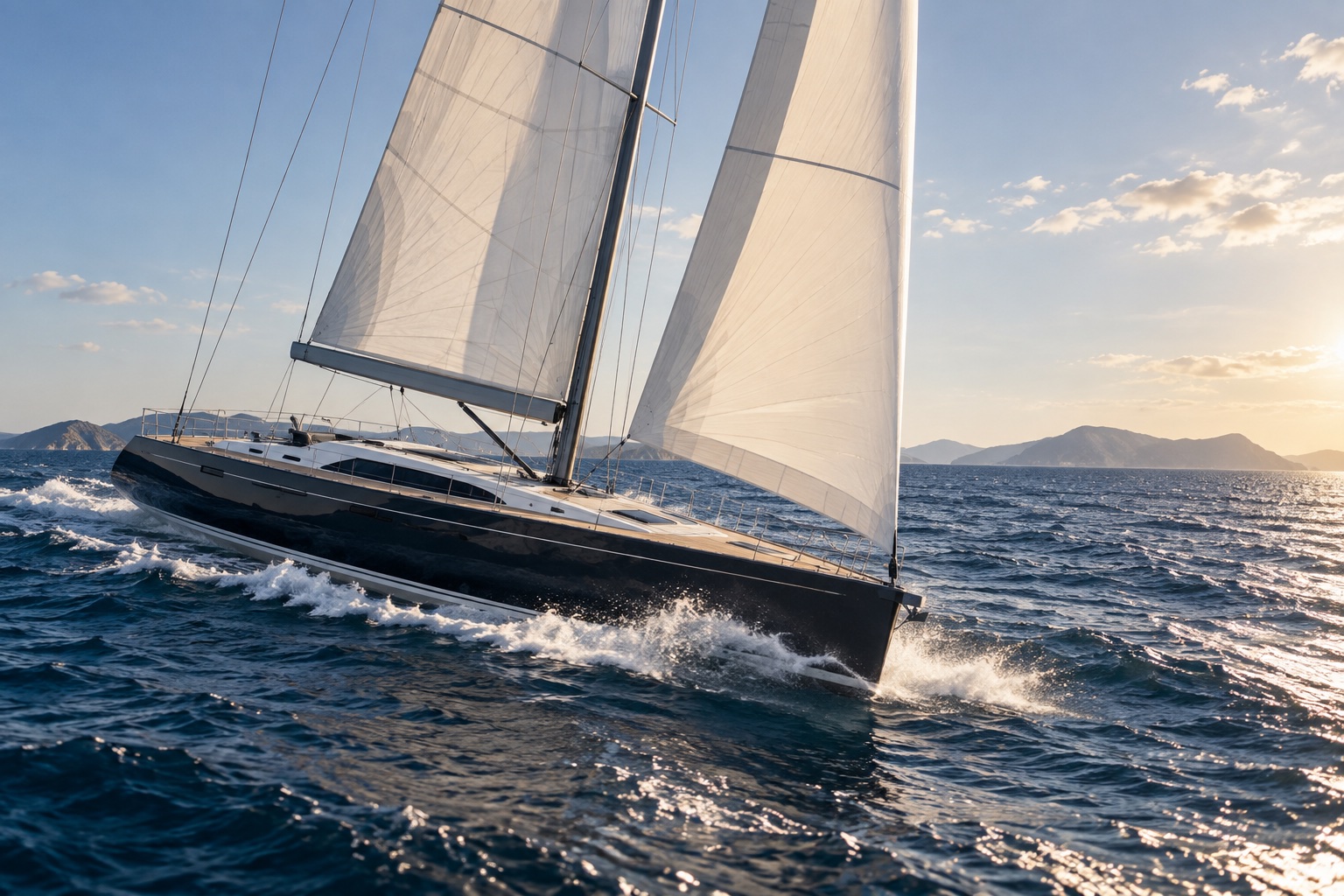
Engines off, twelve knots, no noise but water. The category that turns the passage from an interruption into the best part of the day — and asks something of you in return.
- Length overall
- 20 – 60 m
- Guests sleeping
- 6 – 12
- Crew
- 4 – 9
- Pricing
- Not currently published
What the category covers
A crewed sailing yacht of twenty metres and upward, carrying six to twelve guests with a professional crew who handle the boat entirely. You are not expected to sail her. You are welcome to, on most vessels, and a good captain will teach anyone who asks — but the default assumption is that you are a guest, not crew.
The category splits into three broad families. Performance sloops are built light, usually in carbon or aluminium, with a deep or lifting keel and a tall rig; they will sail at fifteen knots in the right conditions and are exhilarating to be aboard. Cruising sloops and ketches trade some of that speed for interior volume, shallower draft and an easier motion; they are the more common charter proposition. Classic and modern-classic yachts — spirit-of-tradition builds and restored originals — sail beautifully, look extraordinary, and generally offer less interior space and fewer modern conveniences than their length suggests.
One specification is worth understanding before you look at anything: the lifting keel. A yacht drawing five and a half metres is excluded from a great many Mediterranean anchorages and most of the Caribbean shallows. A lifting or swing keel that retracts to three metres transforms where she can go, at the cost of some complexity and a hydraulic system that must have been maintained. Where a yacht has one, it is usually the most important line in her specification.
Who it suits
It suits people who want the sea to be part of the holiday. That sounds obvious, and it is the whole decision. On a motor yacht the passage is a transfer; on a sailing yacht it is the event. If the idea of three hours on a reach with the engines off, the boat leaning fifteen degrees and nothing audible but water along the hull is appealing, this is your category and nothing else will substitute for it.
It suits smaller parties. Six to eight guests on a thirty-metre sailing yacht is generous; twelve on the same boat is tight, because sail-driven hulls are narrower and carry less volume for their length than powered ones. Groups who prize space over experience should look at the motor categories and will be happier there.
It suits guests who are comfortable with a plan that moves. Wind is not a preference, and a captain who says the crossing to the next island is better done on Thursday than Wednesday is protecting your week, not obstructing it. Charterers who need fixed evening reservations three days out will find this frustrating.
It does not suit anyone who is genuinely prone to seasickness, and it is worth being honest about that at the enquiry stage rather than discovering it on day two. Heel is constant under sail, and while it is gentle and predictable, it is not zero.
What to look for
Whether she actually sails
A surprising number of large sailing yachts in charter service motor almost everywhere, either because the rig is undersized, the sails are tired, or the captain finds it simpler. Ask directly what proportion of last season was spent under sail, and ask the age of the wardrobe. Sails older than about six seasons of heavy use will be soft and slow, and the difference is enormous.
Draft, and the lifting keel question
Confirm both figures — keel up and keel down — and confirm the system was serviced this year. Then match them against the cruising ground. Five metres is fine for the Aegean deep-water anchorages and impossible in the Exumas.
The cockpit and the shade over it
On a sailing yacht the cockpit is the living room, and you will spend more waking hours there than anywhere else aboard. Look for a table that seats the whole party, a bimini that can stay up while sailing rather than only at anchor, and enough space that the crew can work the winches without asking guests to move every twenty minutes.
Generator and air conditioning at anchor
Sailing yachts are often quieter about their power arrangements than motor yachts, and some run air conditioning only while the generator is on — which crews are reluctant to do overnight in a quiet bay. If sleeping in air conditioning matters to you, ask specifically whether it runs through the night at anchor and what that sounds like from the cabins.
Tender arrangements
Sailing yachts carry smaller tenders than motor yachts of equivalent length, and often stow them on deck or on davits rather than in a garage. That is fine, but it means fewer and slower trips ashore. If a lot of your week is beach and town, check the tender size and whether there is a second one.
How the total is structured
No rates are published during the site’s educational stage. Ask the authorised party for a current written quote tied to the actual yacht, dates, location and contract, then confirm which operating expenses and taxes sit outside it.
The Advance Provisioning Allowance is typically 20 to 30 per cent of the charter fee, slightly lower than the powered categories for the straightforward reason that fuel consumption is a fraction of the equivalent motor yacht. A sailing week that genuinely sails can leave a meaningful part of the allowance unspent, and it is returned to you.
Berthing is the other place the numbers differ. Marina fees are charged on length and beam, and sailing yachts are narrow, so a thirty-metre sloop frequently berths for considerably less than a thirty-metre motor yacht. Against that, some marinas charge extra for the mast height on the outer berths where sailing yachts must go.
Where it works
The Eastern Mediterranean combines reliable summer wind with short passages and a dense choice of harbours. The Cyclades, the Dodecanese and the Turkish coast between Bodrum and Göcek offer reliable summer wind, short passages between genuinely different islands, and anchorages that reward a boat that can arrive quietly. The meltemi is strong in July and August, which experienced sailors enjoy and nervous guests do not.
Croatia and the Dalmatian islands are gentler — steadier breezes, shorter hops and more protected water — and are an excellent first sailing charter for a mixed group.
The Caribbean trade winds are consistent and warm, and the British Virgin Islands in particular were made for this. Draft is the constraint; a lifting keel or a catamaran opens up a great deal more of it.
The Balearics and Corsica sail well in June and September, when the wind fills in reliably and the anchorages are not yet full. In August the Western Mediterranean is often windless by mid-morning, which is worth knowing before booking a sailing yacht for that fortnight specifically.
Our usual advice
If half your party is enthusiastic about sailing and half is indifferent, book a cruising yacht rather than a performance one. The performance boat rewards the enthusiasts and punishes everyone else; the cruising yacht keeps the whole group aboard and happy, which is the actual objective.
Questions
No. The crew handle everything. On most yachts you are very welcome to helm, trim or simply watch from the cockpit, and a good captain enjoys teaching. But the default is that you are a guest and nothing is expected of you.
A large cruising yacht typically sails at ten to eighteen degrees, which feels considerable on the first afternoon and unremarkable by the second day. Crews reef early on charter precisely to keep the angle moderate. At anchor and under engine the boat is upright.
You motor, at nine to eleven knots, and the week proceeds normally. Every sailing yacht in charter service has ample engine power and fuel. A calm week is a disappointment rather than a problem — which is the main argument for the Eastern Mediterranean, where it is rarely calm in season.
Adjacent categories
Catamarans
Sail without the heel, with far more deck space and a draft that opens up the shallows.
Motor Yachts
When the schedule is fixed, the party is mixed, or the volume matters more than the experience.
Superyachts
Sailing superyachts above forty metres, where the rig and the service are both on another scale.