Yachtwebsite Information About Yachts
info@yachtwebsite.com

Five yacht categories · independent guide

Five categories. One honest question.

Not which is best — there is no such thing — but which one fits the week you actually intend to have.

Size range
14 – 90 m
Guests
6 – 24 sleeping
Categories
Five
Prices
Not currently published
01 — How to read a fleet

Almost every charter that disappoints does so for the same reason: the vessel was chosen from a photograph rather than from a brief. A forty-metre motor yacht photographs magnificently. So does a twenty-metre catamaran. The photographs will not tell you that one of them cannot reach the anchorage you had in mind, or that the other has a flybridge you will never use because your party would rather eat below in the air conditioning.

The categories below are not a ladder. They are five different answers to five different questions, and the most expensive answer is frequently the wrong one. A smaller, simpler yacht can fit the actual week better than the impressive option in a photograph.

There are four variables that actually determine how a week feels, and none of them is length overall. The first is draft — how shallow the water can be before you stop. The second is crew-to-guest ratio, which decides whether service is attentive or apologetic. The third is shade, which sounds trivial until August in the Cyclades. The fourth is tender capability, because a great deal of a charter is spent not on the yacht at all but on the boat that takes you off it.

Length overall is a poor proxy for space, incidentally. A twenty-four metre catamaran has more usable deck and saloon area than a thirty-metre monohull, because beam rather than length is what generates room. Gross tonnage is a better guide, and the volume distribution matters more still: two yachts of identical tonnage can feel entirely different depending on whether the volume went into a full-beam owner’s suite or into four equal guest cabins.

Read each category below as a starting brief, then test it against the people, water, distances and comfort level that matter to you.

02 — Categories

The five

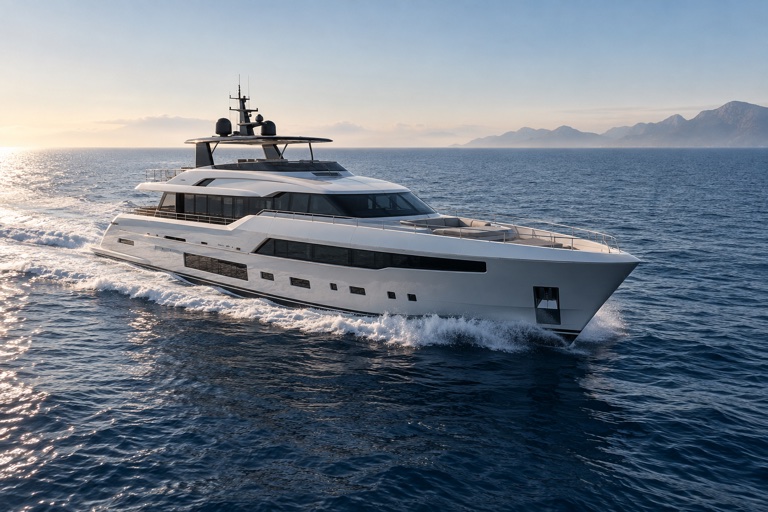
Contemporary flybridge motor yacht cruising across open Mediterranean water

Motor Yachts

01 · 18–40 m

The default, and for good reason. Level decks, generous shade, air conditioning that copes with a Mediterranean August, and enough speed to make a hundred-mile hop a morning rather than a day. Best suited to parties who want the yacht to be a comfortable base between beaches, lunches and towns, rather than an experience in its own right. Expect five to eight crew, four to six cabins, and a tender that will pull a wakeboard.

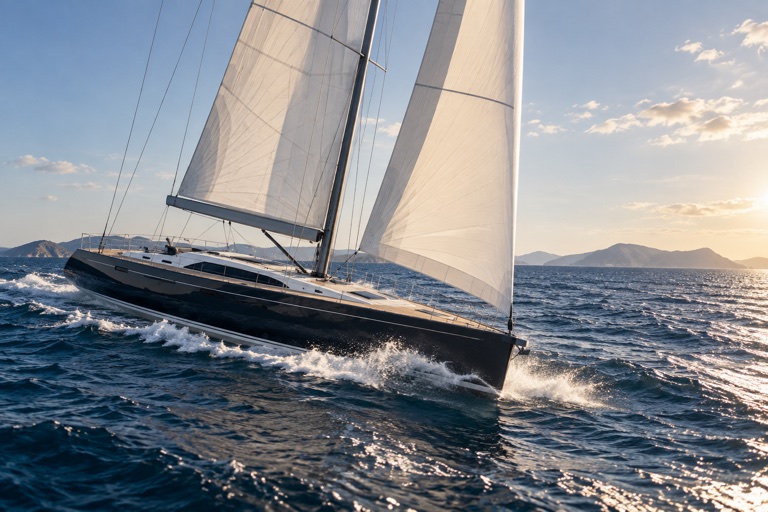
Performance sailing yacht under full sail in a Mediterranean breeze

Sailing Yachts

02 · 20–60 m

Quieter, slower, and considerably more involving. Under sail the engines are off, the boat leans, and the passage becomes the best part of the day rather than the dull bit between anchorages. The trade is real: less interior volume for the length, a degree of heel that not everyone enjoys, and a schedule that has to bend to the wind. For the right guests nothing else comes close.

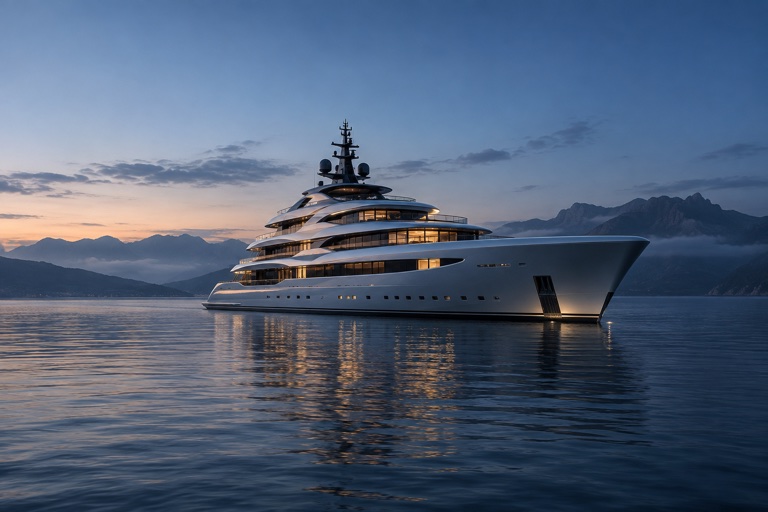
Contemporary multi-deck superyacht anchored at blue hour

Superyachts

03 · 40 m +

A different order of thing. Twelve to thirty crew, a beach club at sea level, a spa, a cinema, and the ability to host thirty people for dinner without anyone eating on their lap. Also a different order of logistics — berths must be booked far ahead, some harbours are simply closed to you, and the running costs inside the provisioning allowance are substantial. Worth it when the guest list, not the itinerary, is the point.

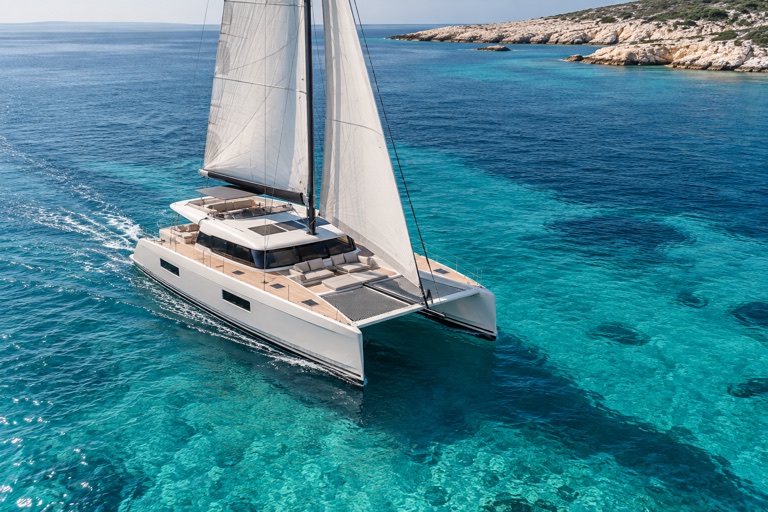
Sailing catamaran crossing clear Mediterranean water

Catamarans

04 · 14–28 m

The most under-rated charter in the market. Two hulls mean almost no heel, enormous deck and lounging space for the length, and a draft shallow enough to anchor where monohulls cannot follow. Cabins sit in the hulls, which gives every couple genuine privacy. For families, for guests who are nervous of the sea, and for the Caribbean and the Bahamas in particular, it is very often the correct answer.

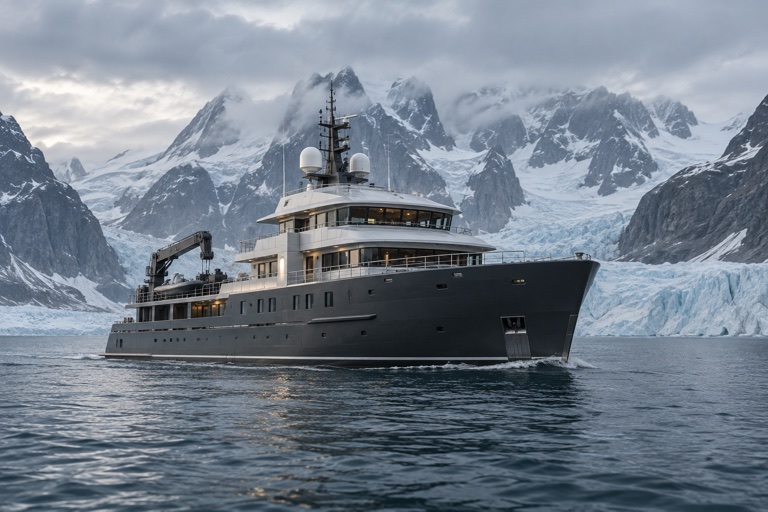
Ice-class explorer yacht navigating a remote high-latitude fjord

Explorer Yachts

05 · 30–90 m

Built to leave and stay away. Reinforced steel hulls, frequently an ice-class notation, fuel and water for weeks rather than days, redundant machinery, and deck cranes capable of launching a serious tender, a dive compressor or a submersible. Slower and less glossy than an equivalent motor yacht, and the only sensible choice for Svalbard, Patagonia, the Kimberley or Raja Ampat.

03 — Comparison

At a glance

General category characteristics only. Individual boats vary widely and must be checked on their own documents and condition.

Category Guests Crew Draft
Motor Yachts8–125–81.8–2.6 m
Sailing Yachts6–124–93.0–5.9 m
Superyachts12–2412–303.2–4.8 m
Catamarans6–122–51.1–1.6 m
Explorer Yachts10–169–183.4–5.2 m

Prices are intentionally withheld during the educational stage. Obtain a current written quote from the authorised party and confirm every included and excluded cost.

Why the price column is absent

A yacht, date and destination are not enough to produce a reliable total. Tax, provisioning, fuel, delivery, berthing and contract structure can change it materially. An old example would create confidence without evidence, so none is shown.

04 — Standards

What to check before trusting a listing

Class, flag and certification

Valid class notation with a recognised society, current flag-state documentation, and — for any vessel carrying more than twelve guests or trading commercially — compliance with the applicable large-yacht code. Ask for the current certificates, not an assurance.

Refit and maintenance history

When she was last out of the water, what was done, and by whom. A ten-year-old yacht with a rigorous maintenance record is a far better week than a five-year-old one that has been run hard and patched cheaply.

Crew stability

How long the captain has been aboard, how often the interior team turns over, and whether the chef is the one in the brochure. High churn is the single most reliable predictor of a mediocre charter.

Insurance and liability

Hull and machinery cover, protection and indemnity cover at an appropriate limit, and confirmation that charter use is actually within the policy terms. It is not always.

Tender and toy inventory

Verified in writing, not inferred from a brochure photograph taken four seasons ago. Including whether the jet skis are licensed for the waters you intend to use them in.

An actual inspection

Use a surveyor appointed by you. A listing photograph, broker walkthrough or old survey is not a substitute for a current independent inspection.

05 — Geography

Where each one works best

Cruising grounds are not interchangeable, and the category that is obvious in one is often a mistake in another. The following is the short version of a conversation we have several times a week.

The Western Mediterranean

The Balearics, Corsica, Sardinia and the Côte d’Azur reward speed and shade. Distances between the interesting places are short, the anchorages are deep enough for almost anything, and August heat makes air conditioning non-negotiable. This is motor yacht country, with superyachts making sense once the party exceeds twelve. Sailing yachts do well here in June and September, when the wind is more reliable and the anchorages are not full.

The Eastern Mediterranean and Adriatic

Greece, Turkey and Croatia are a different proposition. The distances are longer, the meltemi can blow hard for days at a time in July and August, and a great many of the best anchorages are small, rocky and shallow. A sailing yacht comes into its own here, and so does a well-found motor yacht with a captain who knows which bays hold in a northerly. Very large vessels are constrained by berth availability in the islands.

The Caribbean and Bahamas

Consistent trade winds, warm water and — critically — a great deal of very shallow water. Draft is the governing variable, and it is why catamarans dominate the Bahamas, the British Virgin Islands and the Grenadines. A monohull drawing four metres will spend the week looking at places it cannot enter. Winter is the season; hurricane months are not.

High latitudes and remote archipelagos

Svalbard, Greenland, Patagonia, the Kimberley and eastern Indonesia are explorer territory, and the reasons are unglamorous: fuel range, water-making capacity, redundant machinery, hull strength, and a crew who have done it before. There is no sensible way to substitute a conventional motor yacht here, and attempting it is how charters become incidents.
Still not sure which category?

That is the normal state of affairs, and it is precisely the conversation we are useful for.

Talk it through