Category 04 · 14–28 metres
Cata marans
Two hulls, no heel, a metre and a bit of draft and more deck than a monohull ten metres longer. The most under-rated charter in the market.
- Length overall
- 14 – 28 m
- Guests sleeping
- 6 – 12
- Crew
- 2 – 5
- Pricing
- Not currently published
What the category covers
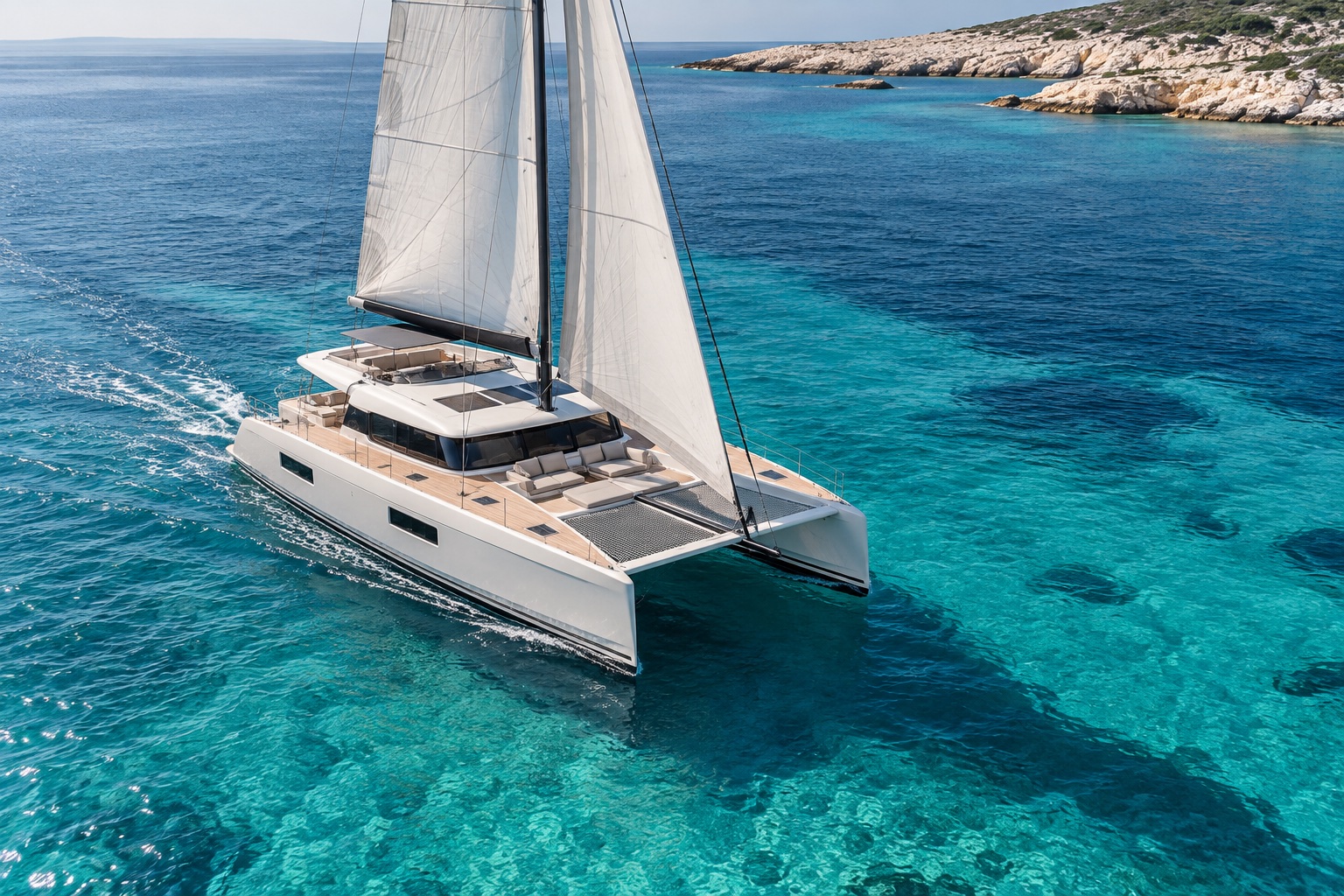
A crewed multihull — two hulls joined by a bridgedeck carrying the saloon — between roughly fourteen and twenty-eight metres. Both sailing and power catamarans are chartered; the sailing version is far more common and is what most people mean by the word.
The architecture explains everything about how they behave. Beam is enormous relative to length: a twenty-metre catamaran is around nine metres wide, where a twenty-metre monohull is five. That width produces stability without ballast, which is why the boat barely heels, and it produces deck area, which is why the living space is so disproportionate. Guest cabins sit in the hulls, one couple per hull section, each with its own heads — genuinely private in a way that a monohull’s stacked lower-deck cabins are not.
Because there is no deep ballast keel, draft is minimal: one to one and a half metres typically, with daggerboards that can be raised further. This single number changes the geography of a charter more than any other specification in this business.
Who it suits
Families, first and foremost. The boat is flat, which matters when children are moving around it. The trampolines forward are the single most popular place on any catamaran with anyone under fifteen. The shallow draft means you anchor close in, so the swim from boat to beach is short and supervised. And the crew is small — often a couple, captain and chef — which makes the whole arrangement feel domestic rather than formal.
Guests who are uneasy about the sea. If someone in the party has been talked into this trip and is quietly dreading it, a catamaran is the honest recommendation. The absence of heel removes most of what people find unsettling, and the motion at anchor is substantially calmer than a monohull of the same size.
Anyone weighing value carefully. Per square metre of usable living space, nothing else comes close. A twenty-metre catamaran costs meaningfully less than a twenty-five metre monohull and gives you more room, more privacy and access to more anchorages.
It suits people who want to be outside. The cockpit and the bridgedeck flow into one another, the foredeck is a genuine second living area rather than a working space, and on most modern designs there is a flybridge lounge above. In practice guests use nearly all of it, which is not true on most monohulls.
What to look for
Bridgedeck clearance
The gap between the water and the underside of the bridgedeck. Too little and waves slam into it — a loud, hollow bang that is harmless but wakes everybody in a chop. Generous clearance is a mark of a properly designed boat and is worth asking about explicitly, because it is never in the brochure.
Crew accommodation
On smaller catamarans the crew sometimes sleep in a forepeak cabin accessed through the guest area, or in one of the four hull cabins — which means you have lost a cabin. Confirm that crew quarters are genuinely separate and that the guest cabin count you were quoted is the count you get.
Daggerboards or fixed mini-keels
Daggerboards sail considerably better upwind and can be raised to reduce draft further; fixed keels are simpler, more robust and slightly shallower on some designs. For a Caribbean week either is fine. For anywhere that involves sailing to windward, boards are worth having.
Power and air conditioning
Catamarans have less space for machinery than their volume suggests. Ask about generator capacity, whether air conditioning runs overnight at anchor, and how much solar is fitted. The better-equipped modern boats run very quietly on batteries and solar for a substantial part of the day, which is one of the real pleasures of the category.
Where the galley sits
Catamaran layouts put the galley either up on the bridgedeck alongside the saloon, or down in one of the hulls. Galley-up keeps the chef part of the day and makes the saloon feel like the centre of the boat; galley-down keeps cooking smells and noise away from the living space and frees the whole bridgedeck for guests. Neither is better, but the difference is felt every single day of the week, and it is the layout question most worth forming an opinion about before you look at boats.
Whether she is a charter-fleet boat or a private yacht
Production catamarans built for volume charter fleets are competent and well proven, but they are finished to a price and they work hard. A privately owned catamaran offered for a limited number of weeks each season is a different experience entirely. Both are valid; the price difference is real and so is the difference aboard.
How the total is structured
No rates are published during the site’s educational stage. Catamaran quotes can use different structures by region, so compare the actual inclusions, taxes, operating costs and dates rather than a headline figure.
Advance Provisioning is generally 25 to 30 per cent, and often comes in lower than budgeted because fuel consumption is modest and catamaran charters spend proportionally more nights at anchor than in marinas. That last point is not incidental: marina berthing for a nine-metre beam is charged at a premium — frequently one and a half to two times the monohull rate — which is a genuine argument for anchoring, and most guests prefer it anyway.
In the Caribbean, many catamaran charters are quoted all-inclusive rather than fee plus allowance, covering food, standard drinks, fuel for a normal week and water sports. That is simpler to budget and is worth asking for by name.
Where it works
The Caribbean and the Bahamas are where catamarans are not merely a good option but the correct one. The British Virgin Islands, the Grenadines, the Exumas and the Abacos are shallow, sheltered and studded with anchorages that a deep-draft monohull cannot enter. Add steady trade winds and warm water and the case is close to unanswerable.
Greece and Croatia work very well, particularly for families. Short passages, calm mornings, and a shallow draft that lets you tuck into the small bays the larger boats cannot use.
The Balearics and Sardinia are excellent in June and September. In peak August the popular anchorages fill early, and a catamaran’s ability to anchor closer inshore than the crowd becomes a distinct advantage.
South East Asia — Thailand, the Andaman Sea and eastern Indonesia — is increasingly catamaran territory for the same shallow-water reasons, with the added benefit that the wide deck is genuinely usable in heat and humidity.
The honest limitation
Catamarans do not point upwind as well as a good monohull, and in a short steep chop the motion is quicker and more jerky rather than the long roll of a heavier boat. If your week is a serious upwind passage, a monohull is the better tool. For almost every other charter brief, it is not.
Questions
The opposite. Two widely spaced hulls give enormous initial stability, which is why a catamaran sails nearly level and sits quietly at anchor. It is one of the reasons the category suits guests who are nervous of the sea.
Yes, and they are worth considering — the same deck space and shallow draft, without the rig, and considerably more fuel-efficient than a monohull motor yacht of similar volume. There are fewer of them in crewed charter service, so availability is tighter.
For a relaxed week with plenty of time at anchor and lunches ashore, generally yes, and the informality is part of the appeal. If you want formal service, three meals aboard daily and a tender on demand, ask for a boat with three or four crew and expect the rate to reflect it.