Category 01 · 18–40 metres
Motor Yachts
Level decks, deep shade and enough speed to make a hundred miles a morning. The category that asks least of your guests — and the reason it is chosen more than any other.
- Length overall
- 18 – 40 m
- Guests sleeping
- 8 – 12
- Crew
- 5 – 8
- Pricing
- Not currently published
What the category covers
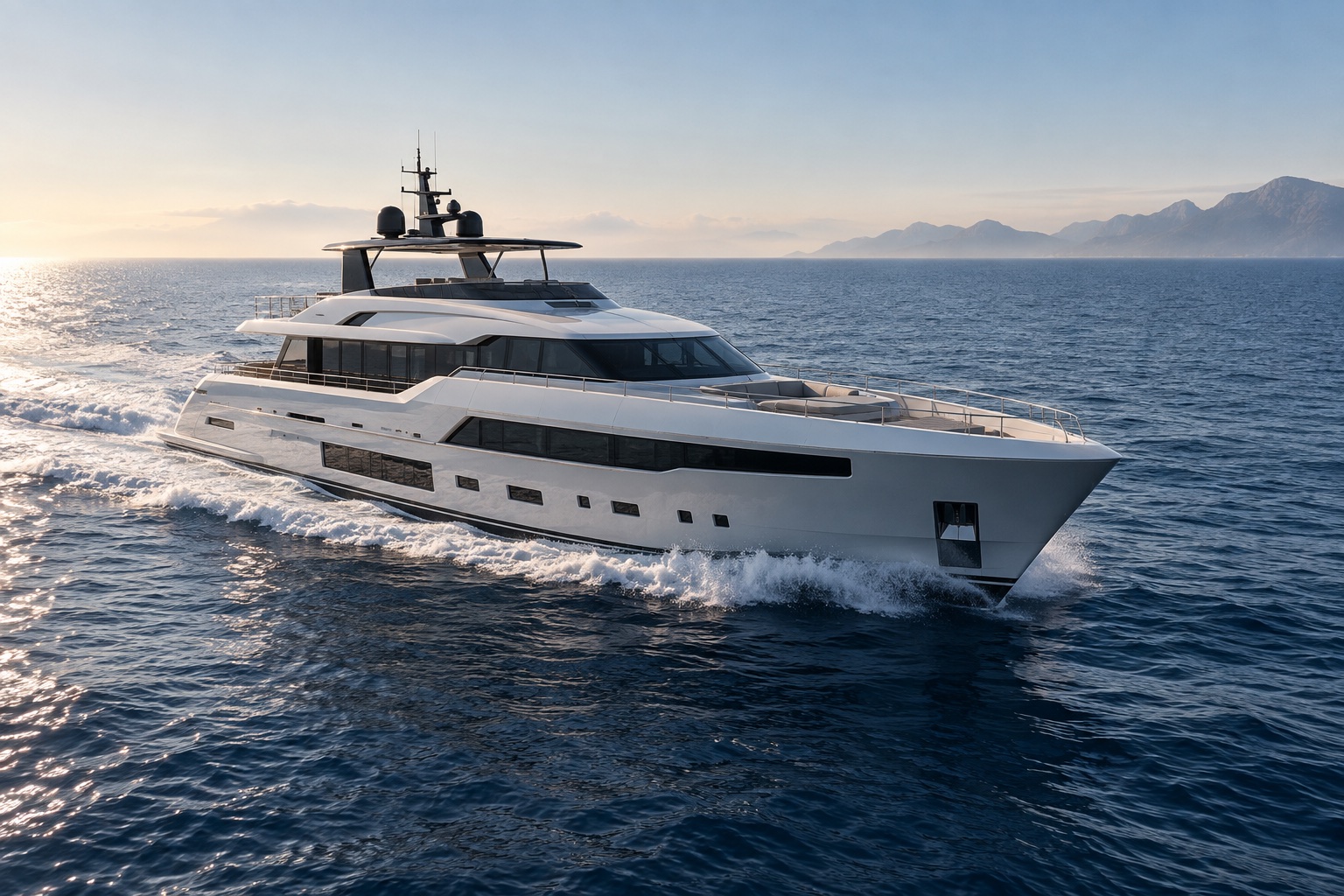
A motor yacht, in charter terms, is a powered vessel of roughly eighteen to forty metres with permanent crew, three to six guest cabins and a layout built around outdoor living. Below that size you are generally into day boats and owner-operated craft; above it the vessel becomes a superyacht, with a different regulatory regime and a different order of cost.
Within the category there are two hull types worth distinguishing, because they behave very differently and brochures rarely explain which you are looking at. A planing hull lifts and skims at speed, will do twenty-eight or thirty knots, and burns fuel at a rate that will surprise you. A displacement hull pushes through the water at ten to twelve knots, uses a fraction of the fuel, and is markedly more comfortable in a seaway. Between them sits the semi-displacement hull, which is what most modern charter yachts in this range actually are: comfortable at twelve knots, capable of twenty-two when the schedule demands it, and reasonable on fuel if you do not insist on the latter.
The layout is more consistent than the hull. Expect a main-deck saloon and dining area, a galley forward or aft of it, guest cabins on the lower deck, a master either forward on the main deck or full-beam below, and crew quarters separated from guest areas. Above sits the flybridge — an upper deck with helm, seating, usually a bar, and on better boats a hardtop that provides shade without blocking the view.
Who it suits
This is the category for parties who want the yacht to be an extremely comfortable base rather than an activity. Nobody is asked to help. Nothing heels. The air conditioning works in every cabin, the passages between anchorages are short enough that guests who are uneasy at sea barely notice them, and there is shade available at every hour of the day without anyone having to negotiate for it.
It suits mixed groups particularly well — the sort of week where two couples want to be in a town by the evening, one wants to read all day, and three children want to be towed behind a tender until they are exhausted. A motor yacht absorbs all of that without the compromise that a sailing yacht would impose on at least one faction.
It suits first-time charterers. Almost everyone’s first charter should be in this category, at the smaller end of it, for one week. You will learn more about what you actually want from seven days aboard a twenty-four metre boat than from a year of brochures, and the knowledge transfers directly into a better second charter.
It suits schedules. If your week has fixed points — a dinner in Portofino on the Tuesday, a flight from Nice on the Saturday — a motor yacht will meet them. Sail cannot promise that, and will not pretend to.
What to look for
Shade, and then more shade
The single most common regret we hear concerns shade. A yacht photographed in May, with crisp white cushions in full sun, looks superb; the same deck in Sardinia in August at two in the afternoon is uninhabitable. Ask specifically about the flybridge hardtop, whether the aft deck has a fixed bimini or a folding one, and whether there is a shaded dining table for the full guest complement. A yacht that can only seat twelve for lunch in direct sun effectively seats four.
Tender and beach access
A great deal of the week happens off the yacht. The relevant questions are how large the tender is, whether it is launched by crane or from a garage, how long that takes, and whether there is a second tender. A single six-metre tender serving twelve guests means somebody is always waiting. A swim platform that folds down into a proper bathing area is worth more than an extra metre of length overall.
Stabilisers
Zero-speed stabilisers — fins or gyroscopic — hold the yacht steady at anchor, not just underway. On a boat without them, a night at anchor in even a slight swell rolls noticeably, and guests notice. For anyone in the party who is uncertain about the sea, this is the specification that matters most, and it is frequently buried at the bottom of the equipment list.
Crew numbers against guest numbers
Six crew for ten guests is a comfortable ratio. Four crew for twelve guests is a stretched one, and it shows in the third and fourth days, when the interior team is tired and the service becomes slower. Ask for the crew list with roles, not just a headcount, and check whether the deckhand is also expected to drive the tender all day.
Age against refit
Build year is a weak signal. A 2011 yacht with a full interior refit in 2023 will present better and run more reliably than a 2019 boat that has chartered hard every summer since delivery. Ask what was replaced, when, and whether the work covered the machinery or only the soft furnishings.
How the total is structured
No rates are published during the site’s educational stage. A current written quote should identify the exact vessel, dates, cruising area, tax treatment and every included or excluded cost; a category average is not a reliable substitute.
On top of that sits the Advance Provisioning Allowance, usually 25 to 35 per cent of the charter fee, paid before departure and held by the captain. It covers fuel, food, drink, berthing, port and cruising taxes, laundry and communications. It is not a fee — it is your money, spent on your instructions, and reconciled against receipts at the end of the week with the balance returned. Fuel is the variable that moves it most: a week of twenty-knot passages can consume three times the fuel of a week spent moving gently between neighbouring bays.
Then there is VAT, which depends on the flag of the vessel, the waters you cruise and where the charter commences, and is genuinely complicated. Expect it to be quoted separately and confirmed in the contract. Finally, crew gratuity is customary — five to fifteen per cent of the charter fee, entirely at your discretion, and paid at the end.
Where it works
The Western Mediterranean is the natural habitat. The Balearics, Corsica, Sardinia, the Côte d’Azur and the Amalfi coast are all built around short hops, deep anchorages and towns worth arriving at in the evening — precisely what this category does best.
Croatia and the Greek islands work well too, with the caveat that the meltemi in July and August can confine a lighter planing boat to harbour for a day or two while a displacement hull would carry on. If your dates fall in high summer in the Aegean, weight the shortlist toward the more substantial hulls.
The Caribbean is viable but not the obvious choice: many of the best spots in the Bahamas and the Grenadines are shallow, and a motor yacht drawing two and a half metres will be excluded from a number of them. In those waters we would usually put a catamaran in front of you first, and say why.
Our usual advice
If it is your first charter, take a twenty-four to twenty-eight metre boat for one week rather than a thirty-five metre boat for five days. The extra days are worth more than the extra metres, and you will learn what you actually want for next time.
Questions
Most charter weeks are cruised at ten to fourteen knots regardless of the yacht’s top speed, because it is more comfortable, far cheaper on fuel and quite fast enough for the distances involved. The higher speed is there for the day you need it — an unexpected weather window, or a flight to catch.
Yes, and most guests end up preferring it. It requires a yacht with sufficient generator capacity and water-making to be independent of shore power, which the majority in this category have. It also makes zero-speed stabilisers considerably more valuable.
Usually, yes — it roughly doubles the usable outdoor space and gives the party somewhere to be that is not the aft deck. The exception is a group who intend to spend the week in the water and the tender, in which case the money is better spent on a larger swim platform and a second tender.
Adjacent categories
Catamarans
More deck space for the money, shallower draft, no heel. The better answer in the Caribbean and for nervous guests.
Superyachts
Once the party exceeds twelve, or the guest list rather than the itinerary is the point.
Explorer Yachts
When the plan involves leaving established cruising grounds behind entirely.