Category 05 · 30–90 metres
Explorer Yachts
Range, redundancy and reinforced steel. Built to leave the marina behind and stay away for weeks — and the only honest answer for the places worth that effort.
- Length overall
- 30 – 90 m
- Guests sleeping
- 10 – 16
- Crew
- 9 – 18
- Pricing
- Not currently published
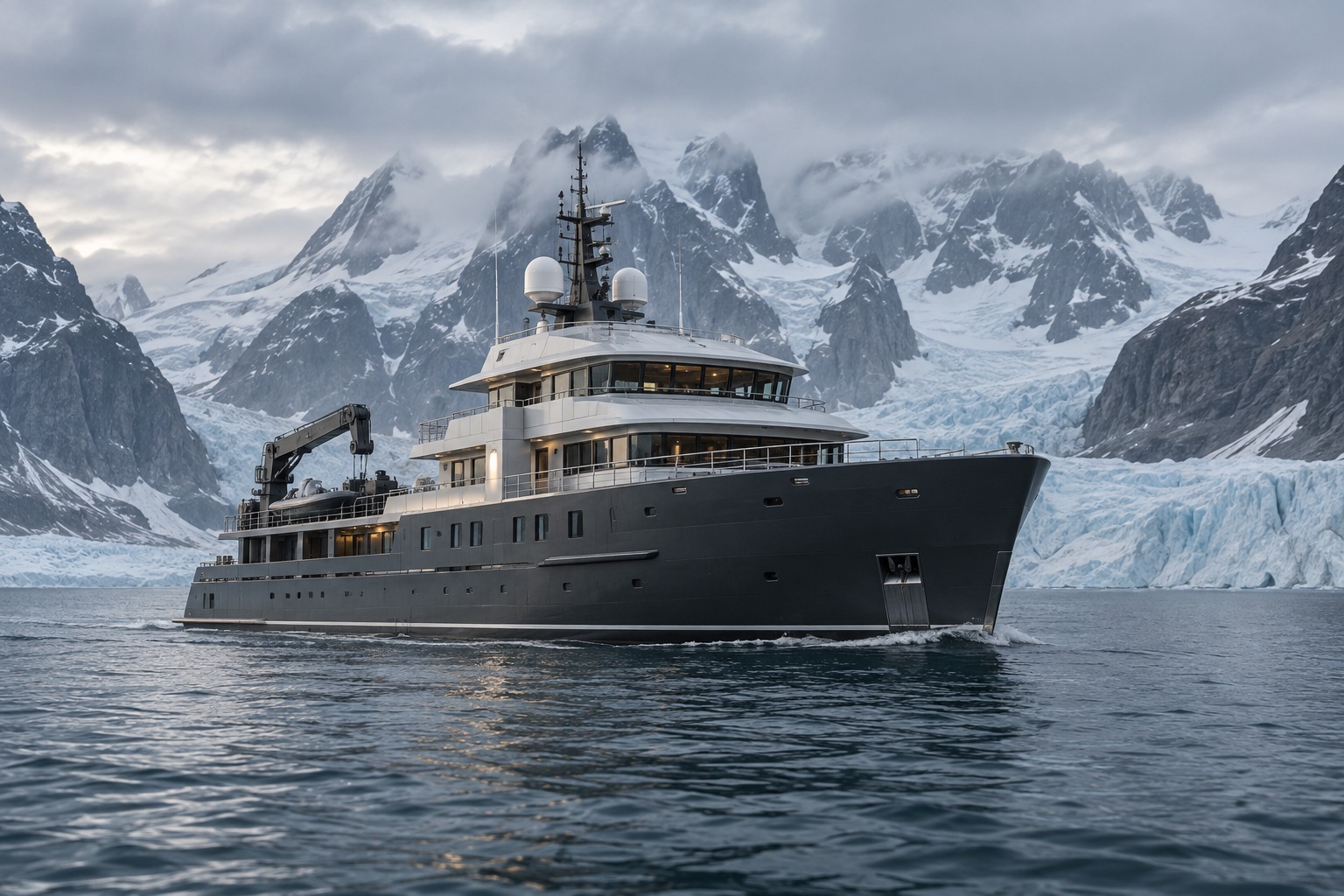
What the category covers
An explorer — the industry also says expedition yacht — is a vessel engineered for self-sufficiency a long way from support. The distinguishing features are not stylistic. They are heavier steel scantlings, greater fuel and fresh-water capacity, duplicated critical machinery, substantial deck equipment, and very often an ice-class notation permitting operation in first-year ice.
Many are purpose-built. A significant number are converted commercial hulls — former supply vessels, tugs and research ships — rebuilt to yacht interior standards while retaining the structure and machinery of a working ship. Converted vessels frequently offer the best value in the category and are often the more capable boats; they are also more variable, and inspection matters more.
The functional consequence is range. A well-found explorer carries fuel for five to eight thousand nautical miles, makes its own water in quantity, freezes and chills provisions for six weeks, and treats its own waste to a standard that permits operation in protected waters where discharge is prohibited. It can therefore go somewhere with no marina, no fuel dock and no chandlery, and stay there.
Who it suits
Charterers whose destination is the point. If the brief is Svalbard in July, the Chilean fjords in February, the Kimberley coast in the dry season or the Raja Ampat archipelago, there is no substitute and no sensible workaround. A conventional motor yacht in these waters is either unable to complete the itinerary or is doing so with margins that a prudent captain would not accept.
Diving, and serious water activity. Explorers carry compressors, nitrox blending, tank racks and often a certified dive team, along with deck cranes able to launch a proper dive tender, jet tenders, kayaks and — on the larger vessels — a submersible. The deck space and lifting capacity are what make this practical rather than notional.
Longer charters. Two, three and four-week programmes are normal here, and the vessels are configured for them. Guest cabins tend to be fewer and larger, storage is genuinely adequate, and the interiors are designed to be lived in rather than photographed.
It does not suit anyone whose priority is glamour or speed. These are ten to twelve-knot ships. They look purposeful rather than sleek, they berth among working vessels as often as among yachts, and the pleasure they offer is of a different kind.
What to look for
Ice class, and which one
Ice notations are not interchangeable. Finnish-Swedish 1C permits light first-year ice in managed conditions; 1A or Polar Class notations permit considerably more. If the itinerary is Greenland or Antarctica rather than northern Norway, the distinction is material and the insurer will care about it even if nobody else raises it.
Range at a stated speed
Range figures are meaningless without the speed they were calculated at. Six thousand miles at ten knots may be three thousand at fourteen. Ask for the figure at the speed you will actually cruise, and ask what reserve it assumes.
Deck crane capacity and reach
The crane determines what you can carry and launch. A five-tonne knuckle-boom with good outreach will handle a nine-metre tender; a two-tonne davit will not. If a submersible, a seaplane or a large dive tender is part of the plan, confirm the lifting capacity in writing against the actual weight of the equipment.
Stabilisation for long passages
Explorers cross oceans rather than hop between bays, which makes roll control a comfort question rather than a luxury. Look for zero-speed fins or a gyroscopic system, and ask whether paravanes — the old commercial solution of weighted birds towed from outriggers — are fitted as a backup. On a four-day passage the difference between a stabilised and an unstabilised ship is the difference between a holiday and an endurance exercise.
Environmental compliance
Many of the best explorer destinations sit inside marine parks or special areas where discharge, ballast and even hull coatings are regulated. Confirm the vessel holds current sewage treatment certification and, where relevant, meets the polar or park-specific fuel rules — heavy fuel oil is prohibited in Antarctic waters, for instance. A vessel that cannot legally enter the place you booked it for is a problem best discovered now.
Medical provision and communications
Ask what medical facility exists aboard, whether any crew member holds an advanced medical qualification, and what telemedicine arrangement is in place. Then ask about satellite communications — not for streaming, but because in remote waters it is the evacuation plan. Reputable operators answer these questions immediately and in detail.
Crew experience in the specific region
This matters more here than anywhere else in yachting. Polar and remote tropical operations depend on judgement that is acquired rather than certificated. Ask how many seasons the captain has run in the region, whether an ice pilot or local guide will be embarked, and who the ground agent is.
How the total is structured
No rates are published during the site’s educational stage. Remote operations can add permits, specialists, repositioning and unusually heavy provisioning, so a current quote must be read alongside the actual expedition plan.
Advance Provisioning tends to run higher than other categories, often 30 to 35 per cent, for reasons that are structural rather than opportunistic. Fuel is consumed over long passages rather than short hops. Provisioning for remote regions must be comprehensive because there is no resupply. Permits, park fees, cruising licences, ice pilots and local guides are real costs — Galápagos, Antarctic operator membership, Indonesian cruising permits and Australian marine park fees all carry substantial charges.
Repositioning is the other consideration. Explorers are often not where you want to start from, and delivery legs of a week or more are common. Sometimes this is charged; sometimes it can be turned to advantage by joining a repositioning passage, which is among the more interesting ways to charter and among the better priced.
Where it works
The high Arctic. Svalbard, east and west Greenland, and the Norwegian coast north of Tromsø. A short season, roughly June to early September, with ice, wildlife and light that justify the whole exercise. Permits and, in places, an ice pilot are required.
Patagonia and the Chilean fjords. Remote, spectacular and genuinely demanding — strong winds, few harbours of refuge and long distances between them. Best December to March.
Eastern Indonesia and Raja Ampat. The richest marine biodiversity on earth, and almost no infrastructure. Explorers with full dive operations are the standard way to see it properly, from October to April.
The Kimberley, north-western Australia. Enormous tides, waterfalls that run in reverse and a coastline with essentially no services. Dry season only, roughly April to September.
Antarctica. Feasible for a small number of yachts with the right notation, crew and IAATO membership. Planned a year or more ahead, and correctly treated as an expedition that happens to be extremely comfortable.
The honest limitation
An explorer used for a conventional Mediterranean August is an expensive way to go slowly. The capability you are paying for only earns its keep where it is needed. If the itinerary is Sardinia and Corsica, we will tell you to charter a motor yacht and save the explorer for the year you go north.
Questions
The good ones are, and their interiors are often more generous than a purpose-built yacht of the same length because the hull volume is greater. Quality varies more widely than in other categories, which is exactly why we inspect before recommending and tell you when we have not.
Two weeks is a sensible minimum for anywhere genuinely remote, and three is better. The distances are long, and a one-week programme spends most of its time in transit rather than at the places you came to see.
Yes, and older children in particular tend to get an enormous amount from it. The considerations are medical distance, the length of open- water passages, and whether the itinerary has enough variety for them. We would usually steer families with under-eights toward tropical rather than polar programmes.
Adjacent categories
Superyachts
The same scale of crew and service, optimised for established cruising grounds and entertaining.
Motor Yachts
For Mediterranean and Caribbean weeks where range and hull strength are not the constraint.
Sailing Yachts
Long-range sailing yachts offer a quieter, slower route to some of the same places.